Funeral Practices of The Woodworkers
Funeral Effigies
The term “Woodworker” stems from the cult's tradition of carving wooden figures of their dead, as well as their proclivity towards recruiting carpenters, carvers and other craftsmen for this purpose. Ideally, all Woodworkers receive an Effigy when they die, but this is reliant on two things: Someone who can provide an accurate likeness, and payment of some kind. An offering of money or items of value like jewelry or precious metals (usually belonging to the deceased) were often used to fund an Effigy. Donations of material can also help lower the price; Effigies were often made of mismatched and recycled portions of wood. All Effigy types have painted-on eyes, with some featuring glass or coin inset irises, but aside from the eyes, a full paint job is rare. The figures are varnished and treated if resources permit.
Full body painted figures are expensive to source and time consuming to produce. In order to cut down on cost, time and materials, and to keep up with the rate at which Woodworkers perished, the Prophet christened two smaller, more affordable types of Effigy: Busts and masks. The majority of Woodworkers chose the cheaper options, but there were usually enough able to afford the full figures that a perimeter of Effigies often stood shoulder-to-shoulder “guarding” Woodworker settlements.
The spiritual purpose of an Effigy is somewhat vague. Rather than two-way communication, the Effigies are mainly a tool for the dead to commune with the living world for the short time until Earthly Heaven is revealed. The idea was that the invisible person, in the Layer of Heaven, would stand in the exact place of the effigy and choose to inhabit the wooden figure. The deceased person the Effigy represents could supposedly see from the eyes, hear from the ears and retain light, painless physical sensation in any wooden appendages they might have. The spirit is not always present inside the Effigy, and must be coaxed to inhabit the wooden body by a living friend or relative. This can be done by calling or singing to the Effigy, stroking the face, positioning the limbs or offering the Effigy a former object of the deceased.
For more information on the construction process of Effigies, click here
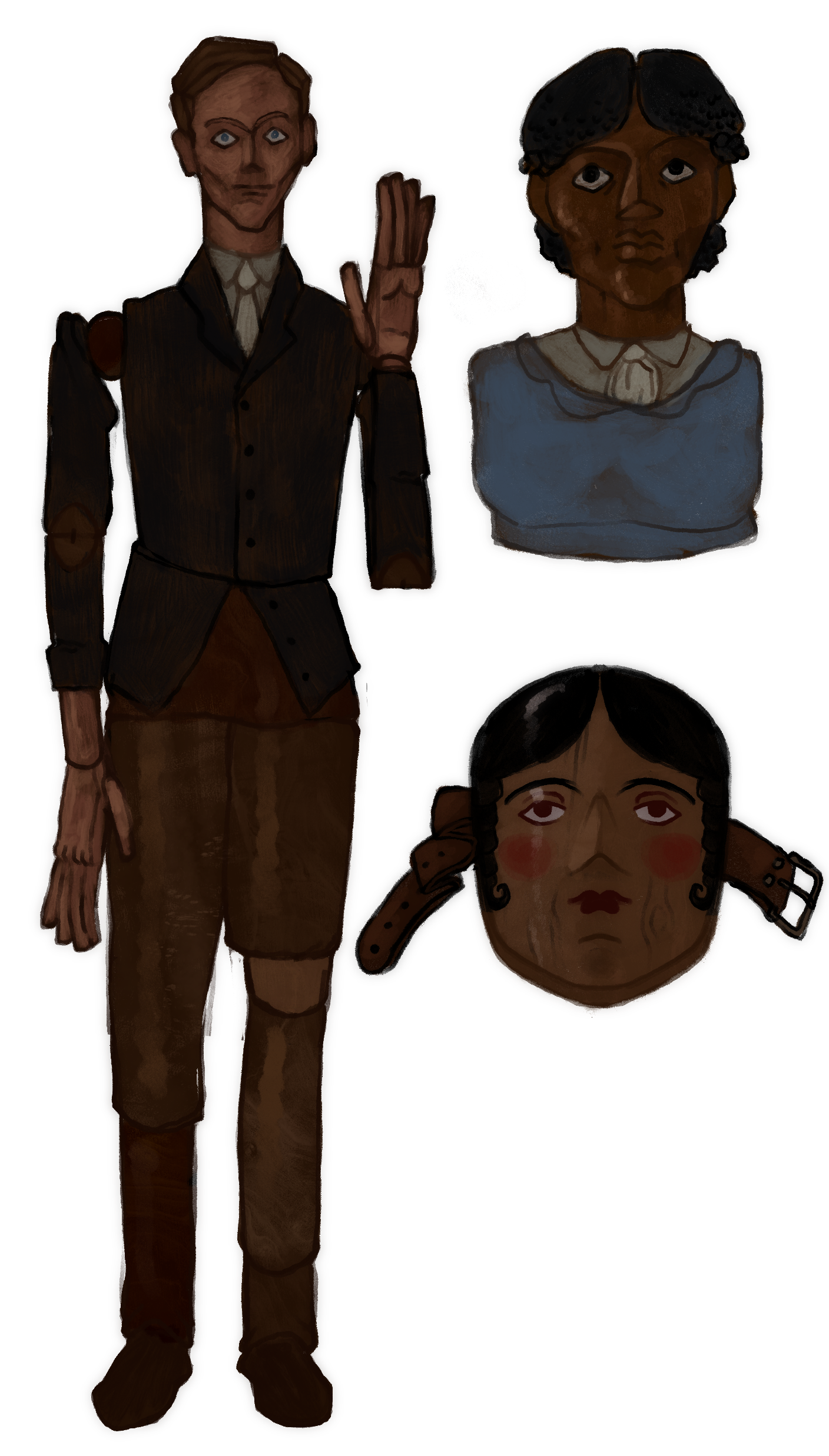
Woodworker belief states an Effigy that is inaccurate in likeness, made before the person dies, made too late, or neglected by friends and family of the deceased can become inhabited by wayward spirits or malicious entities. These entities could conjure termites to eat the Effigy or mold to rot the wood. They may loosen joints and glue so that it falls apart or cause the heavy wooden object to tip over and crush anyone nearby. Possessed, rotten or infested Effigies must be ritualistically reduced to sawdust or kindling, obliterated by fire and remade at the expense of living friends and family. Even though an inhabited Effigy cannot feel pain, attacking or damaging a ‘healthy’ Effigy was considered and punished as genuine assault.
Full Figure Effigies

A Woodworker woman marries her late fiance's Funeral Effigy
Full Figure Effigies vary wildly in stature, articulation, detail and material across different Woodworker communities and across development in time. Some featured clothes carved onto the figure while others wore the real clothes of the deceased. Articulation of the limbs was more common than one would think; Woodworkers were fond of collecting broken furniture, and thus had a lot of hinges and pegs laying around. It was most common to articulate the arms and shoulders and not the legs, so the figure could still reliably stand.
Full Figures not participating in the protective perimeter often stood or sat at the entrances to tents, wagons, cabins or other living quarters. It was customary to verbally greet Effigies and include them in conversation when one is near, as well as bringing them inside during poor weather or excessive temperatures. Sexual activity with Effigies, given the pairing was as appropriate and lawful as it would be in life, was perfectly allowed, if not considered a little strange. Effigies did not often feature any kind of detailed genitalia.
Bust Effigies
Bust Effigies were the most common form of funeral Effigy, not only for their affordability but also their portability and general aesthetic value. With no time needed spent creating a body, Bust Effigies usually had more detailed and carefully crafted faces and hair. Effigies of women sometimes featured drilled holes in the ears and longer necks so that they may wear real or wooden jewelry.
Articulation of the mouth was uncommon, as most Woodworkers thought speaking with the dead was frightening or intrusive. Just as well, articulated mouths could fall off, hang open uncannily, or if possessed by a malicious entity, bite.
Bust Effigies were usually displayed indoors, near beds, on dedicated stands or tables, surrounded by objects belonging to the deceased or offerings from the living. It is customary to keep one's hands still or hidden when in communion or conversation with a Bust Effigy as to not mock the Effigies lack of limbs. One story tells of a woman who spent an afternoon doing needlework in front of an Effigy of her late mother who, in wrathful rebuke, caused the woman to henceforth develop cramps whenever she reached for her sewing supplies.
Effigy Masks
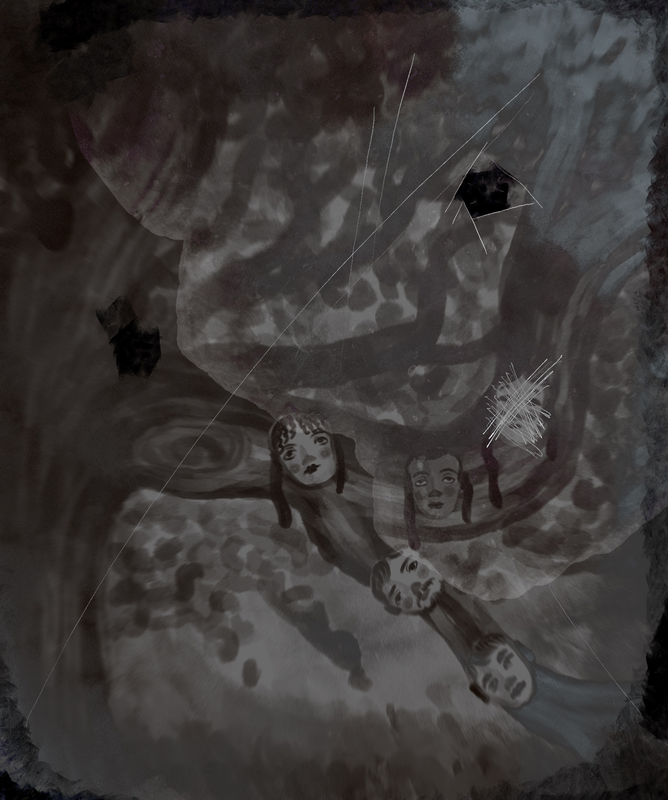
Effigy masks hanging from a tree.
Effigy Masks are the second most common form of funeral Effigy, only for those who have no means to afford a larger form. Masks have a distinct reputation of sorrow, grief, eeriness and quiet. It is subtly implied by the prophet and the inner circle that Effigy masks are a poor tribute to the dead. Nevertheless, Masks are made with the utmost reverence and care, like any other Effigy. They are carved of a single piece of wood and fixed with straps on either side. However, it is important to say that It is extremely forbidden for a human being to “wear” an Effigy mask. The straps are used to tie the mask to a post, bedpost or tree branch to create a “crowded, communal spirit.”
There also exist faceless Proxy Effigies in certain Effigy Houses onto which the bereaved may strap the mask to in order to commune with the dead more effectively. Otherwise, transporting the mask is to be done with the mask securely covered and hidden. Effigy masks are very much personal objects, and are only displayed in private or obscure locations.
If one were caught wearing an Effigy mask, it would be treated as if the person were wearing the skin of the dead. It is also suggested that the dead would inhabit the living person, causing confusion and terror for the dead, believing suddenly that they had been ousted from Earthly Heaven. It was also said to cause sickness and misfortune upon the living for their crimes against a denizen of Earthly Heaven. People caught committing this crime were shunned into a brief period of complete solitude, fasting and prayer, followed by a ritual of cleansing. Only then may the person return to Woodworker society, although their actions are not forgotten.
Effigy Houses
Effigy Houses were a Woodworker’s final resting place. Effigies are typically transported from place to place alongside the cult, but once there are no more living friends or family members of the deceased to commune with, care for and transport the Effigy, they are sent away to live permanently at an Effigy House. The idea was that, since the entire family now lives in Heaven together, there is little use for the spirit to inhabit the Effigy, besides to gaze upon the Earth, which they had full rights to do.
Effigy Houses were typically fenced-in pavilions constructed of wood, with a wooden or iron Seidler Cross above the gated entrance. Under the roof, Effigies were packed in tightly, arranged to create a labyrinth to the center. In the center, one to three blank-faced Effigies sat crouched on the floor. Bust Effigies were lined up on long rudimentary tables, and Effigy Masks hung from the rafters and along the walls and support beams. The blank-faced Effigies were for use by those with Effigy Masks to aid in Communication, allowing the spirit to inhabit more than just the face. This was the only reason for the living to visit an Effigy House- for the rest, this was a place of abandonment. A place for Effigies to rot in peace.
Because of this, Effigy Houses were often constructed up to a mile away from Woodworker settlements. Effigies deemed ready for abandonment were given a procession to the House, carried by Nascents and stood up to rest. The Effigy would be given one final dirge before being left for good.